

Most people buy the wrong tent. Not because they did not research enough, but because they researched the wrong things. They compared weight specs, read brand reviews, and picked the one with the most stars. Then they arrived at a campsite, pitched it in the dark, and realized it was either too small, too hot, too complicated, or built for conditions they would never actually face.
Choosing a tent is not about finding the best tent. It is about finding the right tent for the way you camp. That depends on where you go, how you get there, who comes with you, and what weather you are likely to face. Get those four things right and the rest of the decision becomes straightforward.
This guide walks through every factor that matters, in the order they should be considered.
Quick Guide: How to Choose the Right Tent
Camper's Pick
Best for gear that withstands the elements
The best camping gear earns its place in your pack by delivering reliability when it matters most — a weather-proof tent that braves unexpected storms, a lightweight sleeping pad tailored for sub-zero nights, or a rugged pack built for miles on the trail.
- Oakley Shop camping gear at Oakley
- Mountain Hardwear Shop camping gear at Mountain Hardwear
- Columbia Sportswear Shop camping gear at Columbia Sportswear
- Sorel Shop camping gear at Sorel
- Garmin Shop camping gear at Garmin
Your camping style should guide everything. It determines how much space you need, how light your tent should be, and what features actually matter.
- Car camping: You can prioritize comfort, space, and height since weight is not a concern.
- Backpacking or hiking: Lightweight and compact tents are essential to avoid carrying unnecessary weight.
- Family camping: Larger tents with multiple rooms or dividers provide privacy and comfort.
- Solo or minimalist trips: Smaller, quick-setup tents keep things simple and efficient.
If your trips involve staying in one place for several days, comfort becomes more important than weight. In these cases, understanding how people approach camping with a tent naturally shifts your focus toward space, airflow, and usability over time rather than just portability.
Start With Your Camping Style
The type of camping you do is the most important factor in the entire decision. Before comparing specs or prices, get clear on how you actually use a tent. Every other choice flows from this.
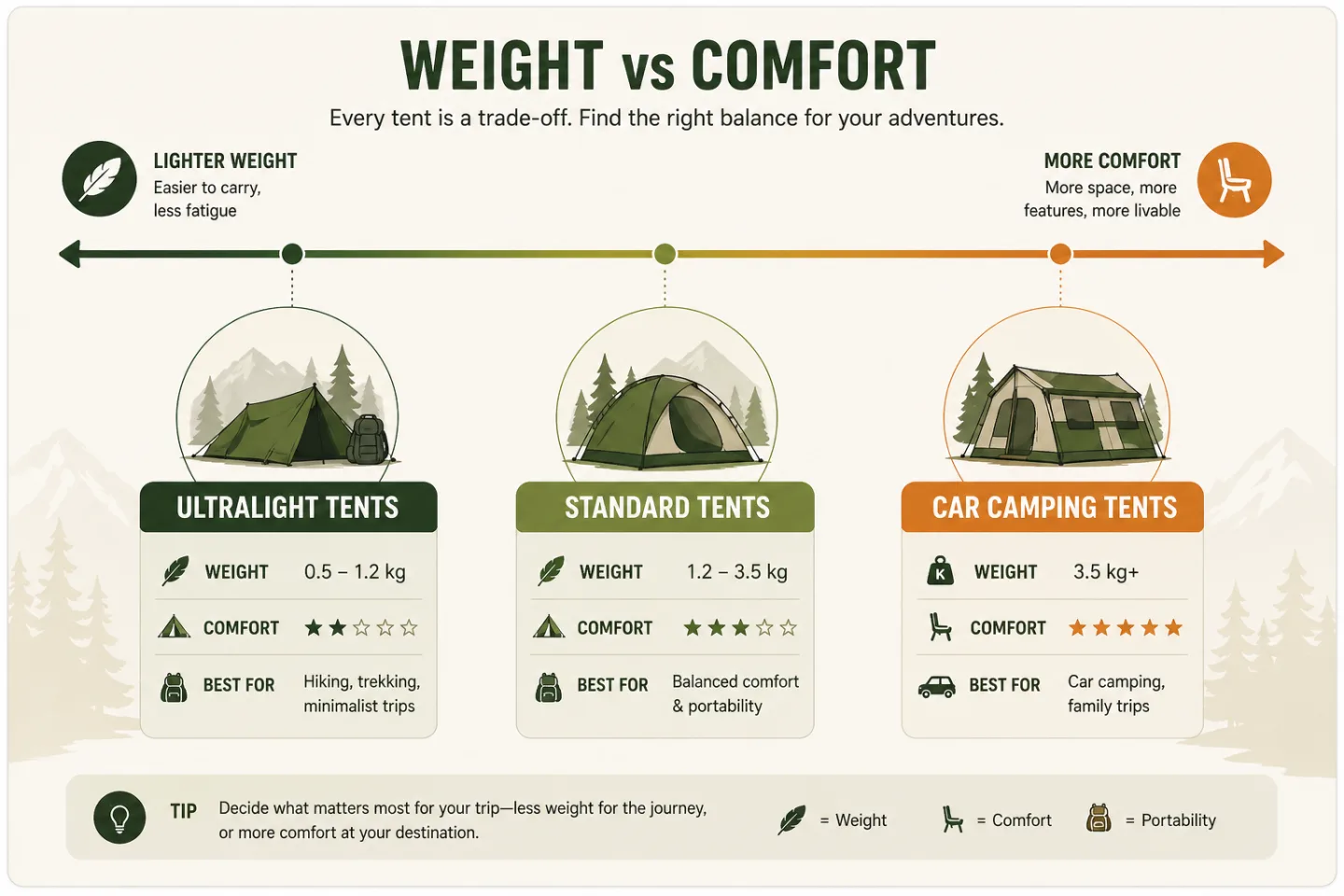
Car Camping Tents
Car camping means driving to your site and pitching within easy reach of your vehicle. Weight is irrelevant because you are not carrying the tent far, which opens up a much wider range of options.
Good car camping tents offer:
- Standing height, so you can move around and get dressed comfortably
- Large floor space, either in one open area or divided into rooms
- Generous vestibules for storing muddy gear outside the sleeping area
- Heavier materials that prioritize durability over portability
Cabin-style tents with near-vertical walls make the best use of floor space and feel genuinely liveable on multi-night trips. If comfort matters more than packability, car camping gives you the freedom to prioritize it.
Backpacking Tents
When your tent lives in your pack and you are covering real distance every day, weight and packed size become the dominant concerns. Everything else is secondary.
A good backpacking tent will be:
- Under 1.5kg for a 2-person shelter, or under 1kg for solo ultralight setups
- Compact enough to fit inside or strap to a 65-litre pack without dominating the load
- Double-walled to manage condensation on multi-night trips
- Strong enough to handle exposed conditions, since you cannot always choose your pitch
Among the best camping tents built for trail use, there are now excellent options that achieve low weight without sacrificing meaningful weather protection.
Family Camping Tents
A family tent has a demanding brief. It needs to fit multiple people, multiple sleeping bags, and the considerable overflow of gear that comes with camping as a group, while still being manageable to pitch and pack down.
When choosing a family tent, prioritize:
- Total floor space over everything else
- At least two doors, so nobody climbs over sleeping bodies at 3am
- Room dividers for privacy on longer trips
- Durable materials and solid pole connections, because family tents take real punishment
The best family camping tent gives you space to live, protection you can trust, and a setup you won’t need a team or instructions to figure out.
Solo and Minimalist Camping
Solo campers want simplicity. A 1-person or 2-person tent that pitches quickly, packs small, and gets out of the way is the goal.
Many solo campers eventually move toward trekking pole shelters or bivy-style systems to cut weight further, but these involve real trade-offs in comfort and usability. If you are new to solo camping, start with a straightforward freestanding 2-person tent. It gives you room to store gear inside, tolerates beginner mistakes, and leaves room to refine your preferences before committing to a more technical shelter.
Choosing the Right Tent Size and Capacity
Tent sizing is one of the most consistently misunderstood parts of buying a tent, and it leads to more uncomfortable nights than almost any other mistake.
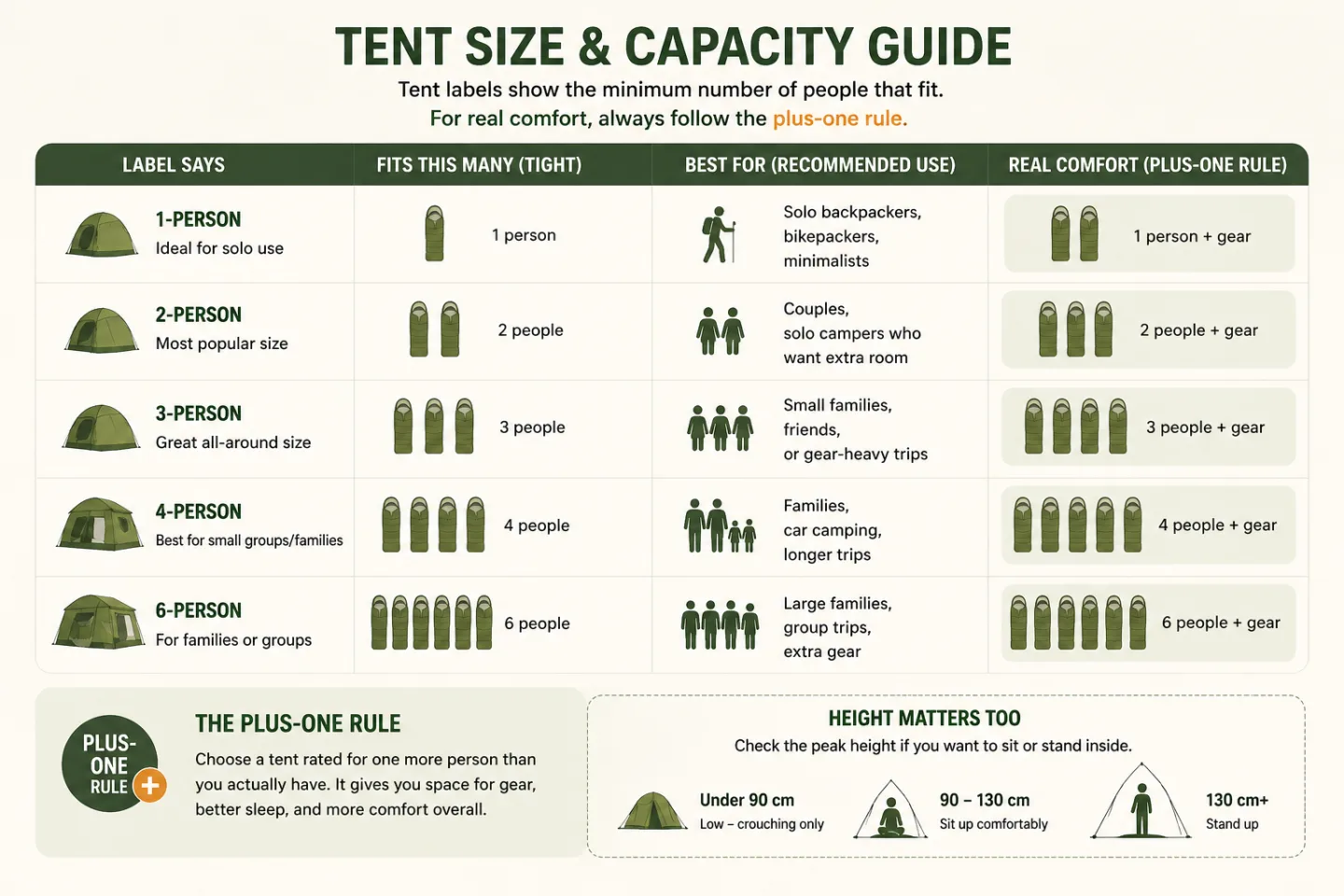
Capacity vs Real Comfort
Manufacturers rate tent capacity based on the number of sleeping bags that fit side by side across the floor. That is it. There is no allowance for gear, for the fact that people move in their sleep, or for any personal space beyond the physical minimum. A 2-person tent will fit two slim adults with nothing else inside and very little room to move. It is a physical minimum, not a comfort rating.
Gear Storage Considerations
Every night in a tent involves gear that needs somewhere to go. Boots, bags, clothing, and wet weather layers all take up space, and if the tent is sized to its exact headcount capacity, that gear ends up on top of you or left outside. A vestibule solves some of this by providing covered outdoor storage, but the sleeping area still needs breathing room to function properly.
When to Size Up
The practical answer is almost always. Use one size above your actual headcount as a starting point:
- Solo camper → 2-person tent
- Two people → 3-person tent
- Family of four → 5 or 6-person tent
The weight and cost difference is usually modest. The comfort difference on a multi-night trip is not. The only time sizing exactly to your headcount makes sense is when you are counting every gram on a long-distance backpacking trip and are genuinely willing to trade space for weight.
Peak Height and Livability
Floor space is not the only spatial factor worth checking. Peak height determines whether you can sit up, get dressed, or move around without constantly ducking.
Two tents with identical floor plans can feel completely different inside if one peaks at 120cm and the other at 180cm. For car camping, look for a minimum of around 180cm if standing comfort matters. For backpacking, full standing height is rarely possible without a weight penalty, but enough headroom to sit upright comfortably makes a meaningful difference over several nights.
Understanding Tent Season Ratings
Season ratings describe the conditions a tent is built to handle. Matching the rating to your actual camping conditions is one of the most consequential decisions in the entire buying process.
3-Season Tents
Three-season tents cover spring, summer, and autumn. They handle moderate rain, light wind, and cool temperatures, and they do it without the weight and expense of a winter shelter. For most campers, this is the right choice. It covers the widest range of typical conditions, offers the best balance of weather protection and ventilation, and is where the strongest concentration of well-tested, well-priced options exists.
If you are buying your first tent and are not planning any winter or high-altitude camping, start here.
3-to-4-Season Tents
These sit between a standard 3-season and a full expedition tent. They use stronger poles, more substantial fabrics, and reduced mesh panelling, which makes them more capable in colder temperatures and stronger winds without going to the heavy end of the market.
They are a strong choice for campers who regularly push into shoulder seasons, camp at altitude, or face conditions that a standard 3-season tent handles only marginally. If you find yourself regularly cold in your current tent or dealing with wind that strains the poles, this is the upgrade worth considering.
4-Season Tents
Four-season tents are built for genuinely extreme conditions. Sustained sub-zero temperatures, significant snow loading, and high winds on exposed terrain are what these tents are designed for.
They achieve this through geodesic pole structures, heavier fabrics, minimal mesh, and low-profile designs that shed snow rather than letting it accumulate. The trade-offs are significant: heavier, more expensive, warmer, and less ventilated than any 3-season option. In mild or moderate conditions, a 4-season tent is uncomfortable and unnecessary. Buy one only if your camping genuinely takes you into extreme winter environments.
Weight and Packability: How Portable Should Your Tent Be?
How you get your tent to the campsite determines how much weight should factor into your decision. For a lot of campers, the honest answer is that it barely matters at all.
Backpacking vs Car Camping
For car campers, tent weight is essentially irrelevant. The tent moves from your storage to the boot to a short carry at the pitch. The difference between a 1.5kg backpacking tent and a 4kg cabin tent is completely undetectable when you are not carrying it on your back.
Weight becomes a genuine consideration when you are covering real daily mileage with a full pack. At that point, every kilogram is felt, and the cumulative effect over a multi-day hike is substantial.
Packed Size Considerations
Packed size follows the same logic. A tent that compresses into a manageable stuff sack that fits inside a 65-litre pack is essential for backpacking. For car camping, it is almost entirely unimportant.
If you are buying for trail use, always check:
- The packed dimensions against your bag before purchasing
- Whether the poles pack inside the stuff sack or separately, since this affects weight distribution
- Whether the footprint packs separately or attaches to the tent, since this changes total bulk
The Trade-Off Between Comfort and Weight
Reducing tent weight almost always involves giving something up. Thinner fabrics are lighter but less durable. Fewer poles cut weight but reduce weather resistance. Single-wall construction saves grams but increases condensation. None of these compromises are wrong in the right context. The mistake is accepting them without a reason to.
A camper driving to a campsite for weekend trips has no reason to sleep in a cramped ultralight tent designed for through-hikers. Choose the trade-off that matches how you actually camp, not an idealized version of how you might camp someday.
Weather Protection: What to Look For
A leaking tent makes everything else about a camping trip worse. Understanding what genuine weather protection involves is one of the most practically important parts of this guide.
Waterproof Ratings Explained
Waterproof ratings measure the hydrostatic head of the fabric, expressed in millimetres. In practical terms:
- 1,500mm handles light rain in calm conditions
- 2,000mm to 3,000mm manages moderate to heavy rain reliably
- 3,000mm and above suits sustained downpours and exposed conditions
Always check the rainfly and floor ratings separately. The floor needs a higher rating than the walls because it is in direct contact with wet ground. A tent with a 3,000mm fly but a 1,500mm floor will let water in from below on a wet pitch.
Seam sealing matters as much as the fabric rating. Unsealed seams are a common source of leaks even on well-rated tents, so look for taped or factory-sealed seams, particularly on the floor and lower sections of the fly.
Rainfly Coverage
Full-coverage rainflies that extend close to the ground on all sides offer significantly better protection than partial designs that leave large gaps at the base. In wind-driven rain, a fly with substantial clearance between its hem and the ground allows water to blow directly onto the inner tent. For any camping where rain is a realistic possibility, full coverage is worth prioritising.
Wind Resistance and Pole Structure
Tent shape has a direct effect on wind performance:
- Dome tents deflect gusts with curved surfaces and perform reliably in moderate wind
- Geodesic tents offer the best wind resistance but come with added weight and complexity
- Tunnel tents are highly stable when properly guyed out but suffer when pitched incorrectly
- Cabin tents maximize interior space but act like sails in strong gusts and are best used in sheltered pitches
Whatever design you choose, look for multiple stake-out points and reinforced guyline attachments. These allow you to tension the tent correctly and significantly improve stability when conditions worsen.
Groundsheet Importance
The groundsheet is the layer between the tent floor and the ground. It protects against abrasion, adds waterproofing from below, and extends the working life of the tent floor significantly. A purpose-cut footprint matching the tent's floor dimensions is worth adding to any tent purchase, particularly if the floor waterproof rating is on the lower end or the ground at your typical campsites is rough.
Tent setup: Easy or Technical?
How straightforward a tent is to pitch matters more in practice than most buyers realize. Arriving at a campsite tired, in fading light or poor weather, and then wrestling with a complicated tent is a frustrating experience that colours the whole trip.
Freestanding vs Non-Freestanding
Freestanding tents hold their shape through their pole structure alone. They do not need to be staked out to stand, which makes them:
- Easier to pitch on hard or rocky ground where stakes are difficult to place
- Simple to reposition once erected
- Faster to set up in general, since there is no guyline tensioning involved
Non-freestanding tents rely on stakes and guylines to maintain their structure. They are lighter and often more packable, but they require more skill, suitable ground, and correct tensioning to perform well. For most campers, particularly beginners, a freestanding tent is the more practical choice.
Pop-up Tents vs Traditional
Pop-up tents use spring-loaded frames that deploy automatically when removed from their bag. They pitch in seconds and require no assembly knowledge. The trade-offs are real though. They tend to be heavier than equivalent traditional tents, offer limited weather resistance, and can be genuinely awkward to fold back down correctly.
For festival camping, short fair-weather trips, or situations where absolute simplicity is the priority, a pop-up tent makes sense. For any camping where weather protection, weight, or durability matter, a traditional pole tent will serve better.
Setup Time in Real Conditions
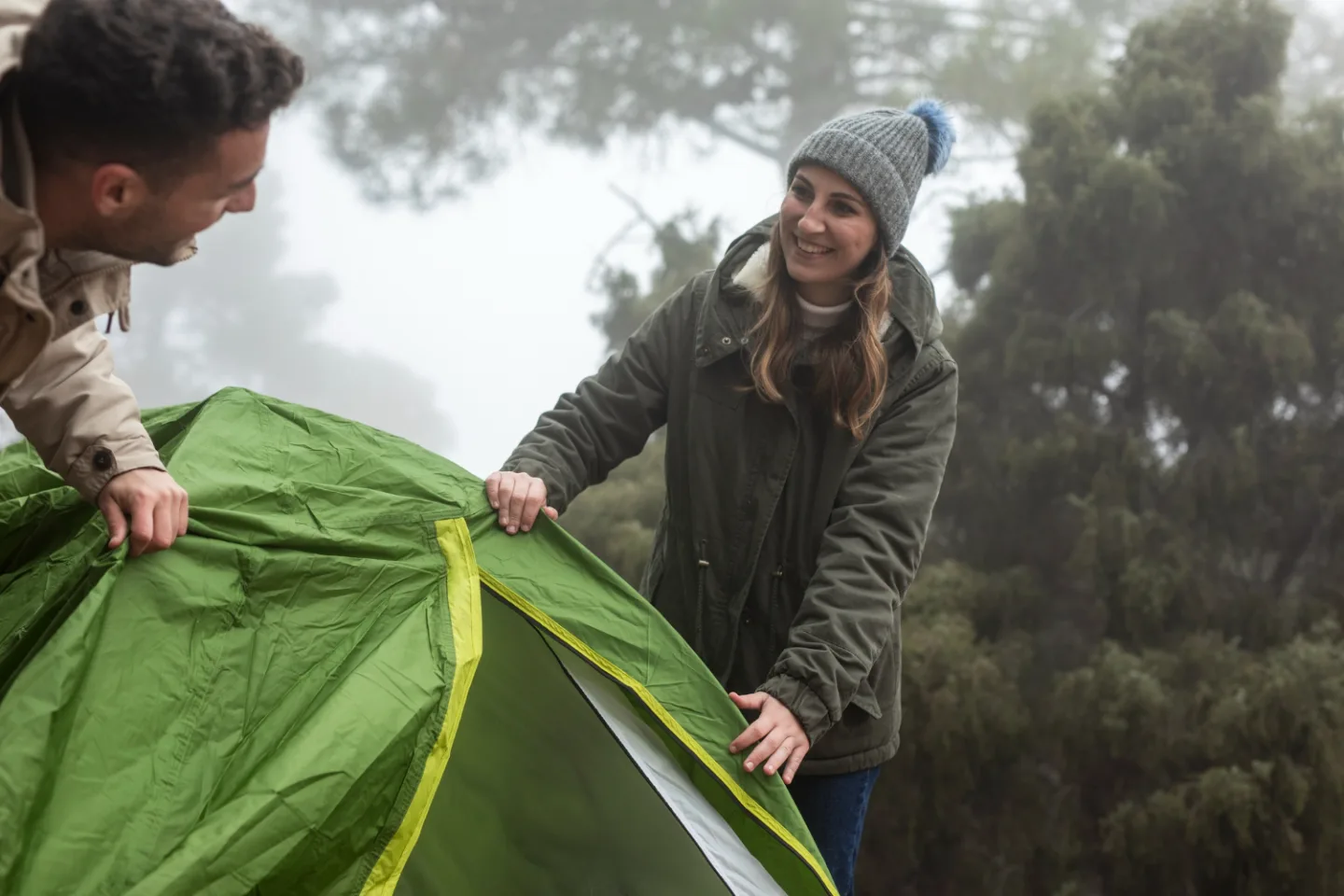
Modern tents with colour-coded poles, hub systems, and clip attachments have made setup considerably faster than older sleeve designs. A tent that goes up in ten minutes in the garden should go up in fifteen under normal camping conditions.
The rule is simple: always do at least one test pitch at home before the first trip. Knowing how to set up a tent properly, understanding which pole goes where, and knowing where the guy line attachment points are before you need them removes a significant source of stress when you are out in the field.
Ventilation and Comfort Features That Matter
Good ventilation is not a luxury feature. It directly affects sleep quality, particularly on warmer nights or in conditions where condensation builds quickly inside the tent.
Mesh Panels and Condensation Control
Every person sleeping in a tent produces moisture through breathing overnight. In a poorly ventilated tent, this condenses on the inner surfaces and drips back down, creating a damp sleeping environment by morning. It is a common complaint among new campers who assume the tent is leaking when the rain has actually stopped.
The solution is airflow:
- Mesh inner panels allow moisture to pass through to the outer fly rather than condensing on the inner surface
- Vented rainfly peaks let warm, moist air escape from the top of the tent
- Double-wall construction maintains a gap between the inner tent and the fly, which is where most condensation occurs
If you are camping in warm or humid conditions, ventilation matters as much as waterproofing in the decision.
Doors and Vestibules
The number and placement of doors affects daily comfort more than almost any other single feature on a shared tent. Two doors on a tent shared by two people means neither person has to disturb the other to get up in the night. It sounds minor. After a few nights in the field it feels essential.
Vestibules extend the usable space of the tent by creating a covered outdoor area for boots, wet gear, and bulky items that do not need to come inside. A tent with a good vestibule gives you more functional living space without increasing the sleeping area, which matters considerably on trips where bad weather keeps you inside for extended periods.
Interior Pockets and Storage
Interior mesh pockets are a small feature with a disproportionate practical benefit. A designated place for a headlamp, phone, glasses, or anything you might need at 2am means you can find it without waking a tent partner or rummaging through a sleeping bag. Gear lofts, where available, add overhead storage without using any floor space. Neither feature alone justifies choosing one tent over another, but when comparing otherwise similar options, these details add up to a noticeably more liveable space.
Quick overview





How to Match Your Tent to Real-World Use
These practical scenarios bring everything together into direct, usable recommendations.
Weekend Camping at a Site With Facilities
A mid-range freestanding 3-season tent sized one above your headcount. Comfort and ease of setup matter more than weight here. A full-coverage rainfly and a floor rating above 2,000mm will handle typical weekend weather reliably.
Hiking and Overnight Trips
A lightweight freestanding 3-season tent, under 1.5kg for solo use or under 2kg for two people. Packed size should fit inside your main pack without dominating it. Double-wall construction for condensation management and a vestibule for boot storage are worth prioritising. For anyone new to trail camping, there is a lot of practical guidance in the basics of camping with a tent that goes beyond the gear itself.
Family Holiday Camping
A large cabin-style 3-season tent with two doors, room dividers, and standing height throughout. Floor space is the priority. Weight is irrelevant. A waterproof rating of at least 2,000mm on both the fly and floor is the baseline, and a straightforward pole system is worth paying for.
Festival Camping
There is no universally best tent, only the tent that best matches how you camp. Be honest about how you actually use a tent, not how you imagine you might. Choose for the trips you currently take, prioritize appropriate specification over a low price, and the tent becomes something you stop thinking about, it just does its job, every time.
Final Thoughts: Choosing a Tent That Actually Works for You
There is no universally best tent. There is only the tent that best matches how you camp, where you go, and what you need it to do.
The most useful thing you can do before buying is be honest about how you actually use a tent, not how you imagine you might use one. Choose for the trips you currently take. If your camping evolves, your requirements will become clearer and upgrading with purpose will be far easier than guessing at the start.
Think long-term when you do invest. A well-made tent bought once lasts years and pays back its cost many times over. A cheap tent replaced every season costs more in the long run and performs worse throughout. Prioritize appropriate specification and build quality over a low price, and the tent becomes something you stop thinking about entirely. It just does its job, every time, regardless of what the weather decides to do.
Frequently asked questions
Is a 4-season tent worth it?
Only if you camp in genuinely extreme winter conditions. Sustained sub-zero temperatures, heavy snow, or exposed high-altitude terrain justify the investment. For most campers, a quality 3-season or 3-to-4-season tent performs better in the conditions they actually face and is lighter and more comfortable to use.
What is the best tent for beginners?
A mid-range freestanding 3-season tent with colour-coded poles and a clip system. It covers the widest range of conditions, pitches quickly, and forgives the learning curve that comes with camping for the first time.
How waterproof should a tent be?
A minimum of 2,000mm on the rainfly for any camping where rain is a realistic possibility. The floor should be rated at 3,000mm or above due to direct ground contact. Seams should be taped or factory-sealed, since a high fabric rating with unsealed seams will still leak in heavy rain.
Are expensive tents really better?
Generally yes, up to a point. Better tents use lighter and more durable materials, stronger pole systems, and more refined waterproofing treatments. The biggest quality jump happens in the mid-range. Beyond a certain price point, improvements become incremental and are mainly relevant to specialist or professional use. For most campers, a mid-range tent from a reputable brand offers the best combination of quality, longevity, and value.